News
Postal Economics Conference 2026
Published on 9 June 2026

Over the course of these two days, which brought together around 70 participants, 22 research papers were presented across seven thematic sessions. The selected works addressed both specifically postal topics—such as route organization, the impact of terminal dues on international postal flows, and the diversification of operators’ activities and the competition law issues this may raise—and topics related to the digital sphere and artificial intelligence, notably e-commerce and digital sovereignty.
The conference hosted speakers affiliated with a wide range of academic institutions—universities and research centers, mainly European but also North American—as well as representatives from Le Groupe La Poste and various public organizations, including the European Commission’s Joint Research Centre, the Bank of Canada, regulatory bodies, and sectoral institutions. This diversity of affiliations enriched the discussions by combining academic perspectives with operational approaches.
Among the highlights of the conference were two keynote sessions delivered by Giacomo Calzolari (European University Institute) and Marcel Boyer (Université de Montréal and associate member at TSE). These addressed, respectively, artificial intelligence and competition on the one hand, and corporate social and environmental responsibility in the face of technological innovation challenges—particularly AI—on the other. A concise summary is provided below.
We warmly thank all the speakers, as well as the conference organizers: Claire Borsenberger (Head of the Doctrine and Modeling Department at the Regulation and Studies Directorate of Le Groupe La Poste), Catherine Cazals, and Helmuth Cremer (researchers at TSE). We also thank our partner, Le Groupe La Poste, for its support of this 13th edition.
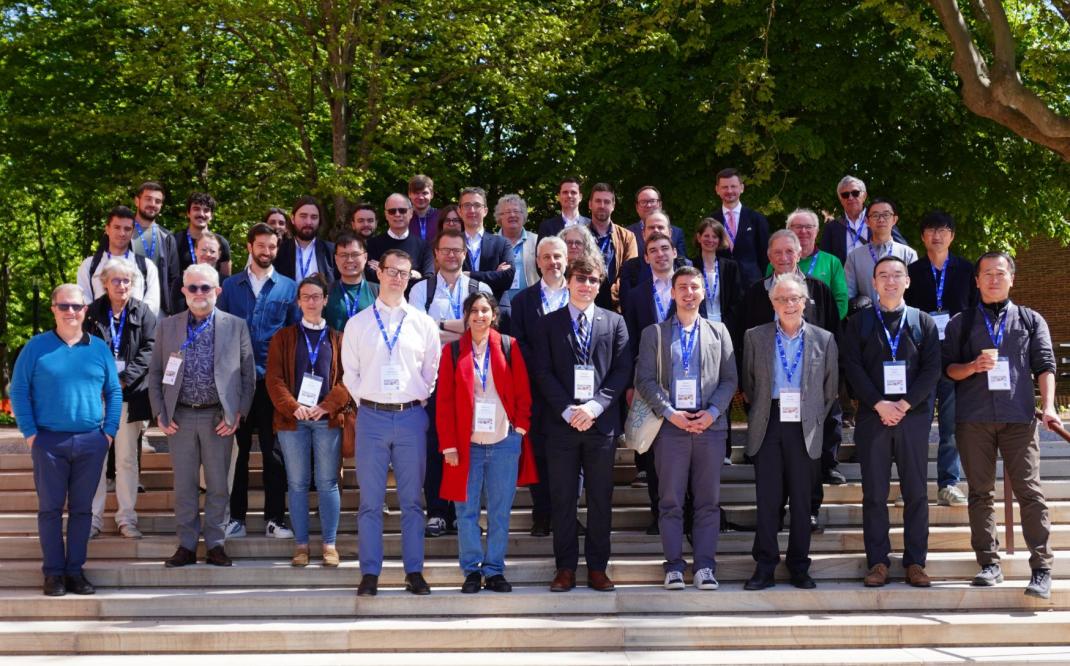
Photo participants of the Postal Conference 2026, TSE building.

13th Postal Economics Conference 2026. Keynote Speaker Marcel Boyer
Keynote lecture 1 - Ethics Equity and Socially Responsible Behavior
During his presentation, Marcel Boyer (University of Montreal and TSE) explained that corporate social and environmental responsibility (CSR) primarily emerges as a response to shortcomings in public authorities’ ability to establish truly competitive market and pricing conditions. He emphasized that the cost of public funds is often poorly understood, as part of the risk remains hidden and is in fact borne by taxpayers rather than lenders. According to him, the central challenge lies in the ability to design institutions that encourage ethical behavior and help limit the unintended consequences of technological innovation. In particular, he drew parallels between the historical excesses associated with the printing press and the contemporary challenges posed by artificial intelligence.
From this perspective, Marcel Boyer stressed that promoting responsible behavior first requires well-functioning competition and accurate pricing. He put forward several recommendations:
- eliminate price distortions, such as subsidies or quotas, which impoverish society;
- create property rights markets and introduce a carbon price to internalize environmental impacts;
- abolish corporate income tax in order to encourage wealth creation and research and development (R&D) rather than tax avoidance;
- carefully support “creative destruction” through institutions that help individuals and businesses adapt to change.
On the social front, the economist emphasized his rejection of approaches he considers overly simplistic. He explained, for example, that banning child labor, in the absence of credible alternatives, can have counterproductive effects. He advocated instead for policies aimed at increasing its opportunity cost, particularly through stronger support for education. He also highlighted the value of managing certain common goods, such as water, through regulated market mechanisms.
Finally, Marcel Boyer referred to the work of Helmuth Cremer conducted with other researchers, recalling that CSR can in no way substitute for well-designed public regulation. In the absence of adequate policies, firms—even when they pursue collective welfare objectives—remain constrained by profitability requirements that move them away from the social optimum. In conclusion, he stressed that a combination of instruments—particularly Pigouvian taxes and targeted subsidies—remains essential to reconcile social responsibility with economic viability.
Keynote lecture 2 – Artificial Intelligence
In his keynote, Giacomo Calzolari (European University Institute) explained that artificial intelligence (AI) should primarily be understood as an enhanced prediction technology capable of profoundly transforming how markets operate. He emphasized that this transformation relies on a double delegation: on the one hand, firms delegate pricing and certain strategic decisions to automated systems; on the other hand, consumers delegate information search and purchasing decisions to algorithmic agents. According to him, this shift marks a transition from mass markets to personalized bilateral interactions, sometimes described as “markets of one.”

Keynote speaker Giacomo Calzolari
Giacomo Calzolari also highlighted the competition risks associated with the automation of supply. He explained that reinforcement learning algorithms can converge toward price levels close to those observed under monopoly conditions, without any explicit human coordination. He stressed that this form of endogenous collusion, supported by algorithmic punishment mechanisms for deviations, is particularly difficult for regulators to detect and address. Furthermore, recommendation systems, although individually rational, may reduce demand elasticity and promote market concentration, to the detriment of overall surplus.
He qualified this assessment, however, by noting that the emergence of agentic buyers could alter these dynamics. By adopting strategic behaviors—for instance, by manipulating the perceived elasticity of their demand—these agents may encourage sellers to pursue more competitive strategies, thereby improving overall welfare. He nonetheless pointed out that in markets where both supply and demand are fully automated, analysis becomes significantly more complex: agents may manipulate the parameters of their objective functions, leading to multiple equilibria whose efficiency and surplus distribution remain uncertain.
Finally, Giacomo Calzolari stressed that current regulatory frameworks remain insufficient in the face of these transformations. He highlighted the urgent need to develop tools ensuring the transparency and auditability of autonomous systems, while also underlining the importance of designing new institutions adapted to the governance and interoperability of algorithms. In conclusion, he argued that AI is transforming the very nature of economic interactions, making it essential to adapt analytical and regulatory frameworks in order to preserve effective competition and efficient market functioning.
Usefull links:
- TSE Infrastruture & Network Center and TSE Digital Center
- The program and the main papers presented are available on the event webpage.
- Learn more about our partnership with La Poste Groupe.
Published in TSE Reflect September 2026.
See also

Postal Economics Conference 2024
-
Corporate Relations
-
Partnership research
-
Digital
-
Infrastructure and Networks

Discussion panel on decision-making under risk and uncertainty
-
Corporate Relations
-
Energy and Climate
-
Finance
-
Infrastructure and Networks
-
Partnership research

How can we solve the economic equation of data spaces?
-
Corporate Relations
-
Partnership research
-
Digital