TSE Master of Science M2 year

Introduction
Program Starting September 2028

The M2 year of the TSE Master of Science is entirely dedicated to specialization. Bulding on the analytical and quantitative foundations acquired during M1 year, students choose one specialization track aligned with their academic interests and career ambitions.
Through advanced coursework applied projects and professional development, students strengthen both their technical expertice and their practical skills. They learn alongside internationally recognised researchers while benefiting from close links with industry, public institutions and international organisations.
Whether pursuing a career in the private sector, public policy or doctoral research, graduates leave with the knowledge and experience needed to tackle today's most complex economic chalenge

Program Structure
A year dedicated to specialization
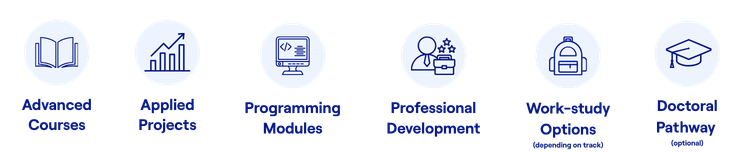
M2 year is designed to deepen your expertise through advanced courses, applied projects, programming modules and professional development. Depending on the track, students may also follow a work-study path or prepare for doctoral research.
Professionaly oriented specialization
Develop advanced expertise in econometrics, machine learning and data analysis
│Field: Economics
│Department: Economics
Why this program ?
Modern economics increasingly relies on data-driven analysis to understand complex economic phenomena and support decision-making in both the public and private sectors. The rapid growth of large datasets, machine learning techniques, and evidence-based policy evaluation has created a need for economists who can work with complex data sets, apply rigorous econometric methods, and translate quantitative results into meaningful empirical conclusions, using both reduced-form and structural approaches.
As a result, companies, financial institutions, and public administrations need professionals who can combine strong economic knowledge with advanced skills in econometrics, machine learning, and data management.
This track aims to provide students with advanced methodological and empirical skills in econometrics and data analysis, enabling them to conduct rigorous empirical analysis and solve real-world economic problems, across fields as diverse as finance, health, public policy evaluation, industrial organization,… Its objective is to train highly qualified economists and analysts who are proficient in modern econometric techniques, advanced machine learning tools, programming, and database management. The program seeks to develop both analytical rigor and practical expertise, training students to master both reduced-form and structural approaches to empirical economics, ask the right questions, choose the appropriate tools, and produce practically relevant results.
The track combines strong methodological training with practical applications across various fields of economics. Students receive advanced methodological courses in econometrics, machine learning, time-series analysis, panel data methods, microeconometrics, non-parametric techniques, database management, …. as well as training in structural econometric modeling, from model specification to estimation and counterfactual analysis. The track also includes a year-long empirical project, allowing students to apply their skills to real datasets while developing teamwork and problem-solving abilities. A key strength of the program is its strong empirical orientation: most courses focus on applied analysis rather than purely theoretical approaches. Teaching is delivered by internationally recognized faculty members with expertise in econometrics, empirical economics, finance, and industrial organization. Overall, the track provides students with a solid methodological foundation combined with practical experience, making them highly competitive in the labor market and well prepared for further professional careers.
Career/Job
Consultant│Analyst│ Economist│Economist │Data scientist│For consulting firms│Large companies in the industrial sector│Banking│Insurance│Central Banks│Government departments
A versatile work study program combining economics, stastistics and business application
│Field: Economics
│Department: Economics
Why this program ?
To address the many complex challenges they face, economic stakeholders need versatile professionals who are proficient in a wide range of applied economic analysis methods and their applications.
This specialization track offers a generalist work-study program. It aims to train generalist economic engineers capable of applying their knowledge of economics and using statistical and econometric methods to analyze macro- and microeconomic issues.
The program offers courses in economics (pricing, international economics, public policy evaluation, macroeconomics, cost-benefit analysis) and forecasting analysis (time series, marketing, machine learning). It also provides knowledge in prudential regulation and banking strategy, corporate finance, and ethics.
Career/Job
Consultant│Analyst, economist│Economist │Data scientist│For consulting firms│Large companies in the industrial sector│Banking│Insurance│Central Banks│Government departments
Study competition, from strategy and market regulation
│Field: Economics
│Department: Economics
Why this program ?
The EMO track addresses a key challenge: understanding how firms, markets, and public institutions interact in increasingly complex and rapidly changing environments.
The track aims to train students to analyze strategic behavior, evaluate market performance, and design effective economic policies and regulatory frameworks.
By combining industrial organization, econometrics, and applied economics, the program equips students with the tools needed to work in competition policy, market regulation, and firm strategy in both private and public sectors. Students develop expertise through advanced courses in industrial organization, incentives, and econometrics, while also benefiting from applied projects, professional development, and connections with major firms and institutions. Overall, the EMO track leverages TSE's internationally recognized strengths in industrial organization and competition policy.
Career/Job
Analyst in (economic) consulting companies │Economist in competition agencies and other regulatory bodies│ Analyst in pricing and marketing departments of private companies
Understand and anticipate financial, environmental, geopolitacal and technological risk
│Field: Economics
│Department: Economics
Why this program ?
Global risks (such as climat and biodiversity, wars and geopolitical crises, energy and supply shocks, public health, natural disasters, financial crises, political instability, cyber and AI) are the prerogative of forward-looking firms and institutions that think ahead and want understand threats and opportunities.
The EGR track trains economists and professionals who can work on the analysis, anticipation, evaluation, mitigation/prevention of future challenges and global risks. EGR is a unique program. It puts equal emphasis on quantitative skills in econometrics and data, broad foundations in economics (notably macro) as well as finance. Hence, it differs from masters in finance or risk management.
Career/Job
Consultant│Analyst│Economists for consulting firms│Large companies in the industrial sector│Banking │Insurance│Central banks│ Government departments
Design and evaluate public policies using rigorous economic methods
│Field: Economics
│Department: Economics
Why this program ?
Public policy and development are at the core of the public debate. Issues such as education and health and other public policies, democracy, foreign aid, governance, human development, infrastructure and effects of political and economic institutions, are of concern, not only to academics, but also to the general public all over the world.
The Program is training students on Public Policy, with strong economic analysis for policy design and strong econometric tools for policy evaluation with a particular focus on development and international institutions.
Career/Job
International, European and National (french…) institutions in Public Policy - Examples: WB, OECD, BdF, INSEE│Development Consulting
Address climate, energy and sustainability challenges through economics
│Field: Economics
│Department: Economics
Why this program ?
Environmental challenges are among the most pressing policy issues facing societies today. Climate change, pollution, energy transition, biodiversity loss and the sustainable management of natural resources require decisions that are both technically complex and politically consequential. Governments, firms and international organizations need to design policies that reduce environmental damage while taking into account economic incentives, distributional effects, technological constraints and behavioral responses. This creates a strong demand for graduates who can combine rigorous economic reasoning with quantitative methods and a detailed understandingof environmental policy instruments.
The EEP track responds to these challenges by training students to assess, analyze and recommend economic policies and strategies aimed at tackling environmental issues and managing natural resources. Its value lies in its ability to connect environmental problems with concrete policy tools, such as environmental taxation, emission trading schemes, standards, labels, cost-benefit analysis and policy evaluation. The track is therefore relevant not only for students interested in environmental economics, but also for those aiming to work in public policy, consulting, regulation, research, international organizations or firms facing sustainability constraints.
The program achieves this objective through specialization in environmental and energy issues through courses such as Valuing the Environment, Cost-Benefit Analysis, Energy Economics and Climate Policy, Ecosystem Management and Policies, Advanced Environmental Economics and Topics in Environmental Economics. The track also includes complementary training in areas such as causal inference, sustainable development, biodiversity, and ecology. By combining theory, empirical tools, policy analysis and exposure to real-world expertise, the track equips students with the skills needed to evaluate environmental policies and contribute to the design of sustainable economic strategies.
Career/Job
Consulting in environmental valuation and environmental policy design and evaluation│Public administration, especially Ministries of Finance and Environment│Private-sector ESG and sustainability reporting functions│International organizations (eg. AIE,OECD)│Energy and utilities (e.g. ENGIE, EDF); NGOs; and research institutions│Typical positions include environmental economist│Policy analyst│Consultant│ESG analyst│Cost-benefit analysis specialist│Energy and climate policy analyst│Research assistant and researcher
A unique double degree combining Economics and Law
│Field: Economics
│Department: Economics
Why this program ?
This track is a double degree in Economics and Law. The combination of these two disciplines meets a genuine need in the job market for specialists able to address complex issues requiring the knowledge and modes of reasoning specific to both fields, whether in relation to the strategic behavior of firms or individuals from an economic perspective, or to the legal classification of conduct (and procedure) in the event of disputes from a legal perspective.
Students are trained in industrial organization modelling and acquire the ability to analyze and understand how markets function and how firms behave strategically. They also develop a rigorous understanding of the rules of competition policy and law.
Career/Job
Economic consultants / lawyers│Private sector│Public administrations (especially competition authorities and sectorial regulators)
Combine economics, artificial intelligence and statistics to analyse complex data
│Field: Econometrics and Statistics
│Department: Mathematics and Statistics
Why this program ?
The track Data Science for Social Sciences addresses the growing challenge of extracting reliable and actionable insights from increasingly large, heterogeneous and complex social and economic data, in order to support evidence-based policy and decision-making. The track aims to give the students a solid culture in economics, statistics and data science, as well as in various related fields of applied mathematics.
- The track target skills are:
- Using the latest methods in machine and deep learning
- Processing and modeling of complex data
- Mastering statistical software and massive database management
- Gaining direct exposure to professional work environments with statistical consulting workshops
Career/Job
Economic analyst│Consultant│Data scientist and project manager for all data driven policy and decision-making requirements│Careers in public institutions to orientate public policies or to impact decisions of institutions│Major companies in finance │Industrial sector│Banking │Insurance│Doctoral studies and academic career
A work-study programme focused on applied statistics and econometrics
│Field: Econometrics and Statistics
│Department: Mathematics and Statistics
Why this program ?
The track addresses the growing need for professionals able to turn complex economic, financial, social and institutional data into reliable statistical analyses and operational decision-making tools, while being immediately effective in professional environments.
The track in Statistique et Econométrie is designed as a work-study/apprenticeship track. It trains students for rapid professional integration as statisticians, econometricians and applied data specialists, with a strong grounding in economics, econometrics and statistics. The apprenticeship format enables students to tackle real data challenges directly within companies and institutions, while developing advanced statistical and econometric expertise.
The track focuses on advanced and applied statistical and econometric techniques, software practice (R, Python, SAS, Excel) and database management. Students learn to process complex data (panel, survey, survival, graph, extreme and spatial data) using semi-parametric, non-parametric and learning methods, while gaining direct professional experience through apprenticeship. The apprenticeship format supports direct recruitment after graduation.
Career/Job
Statisticians│Econometricians│Data scientists/data analysts│Scoring and credit-risk analysts│Quantitative marketing analysts│Survey/sampling specialists│Spatial/geomarketing analysts│Statistical consultants│Main sectors: banking, insurance, public institutions│Consulting, industry│Market research│Health/pharma, and companies or institutions relying on complex data analysis
Advanced quantitative training at the intersection of mathematics, economics and AI
│Field: Applied Mathematics and Statistics
│Department: Mathematics and Statistics
Why this program ?
The track addresses key challenges at the interface of applied mathematics, statistics, economics, and artificial intelligence, where rigorous quantitative methods are needed to model, predict, and support decision-making. It also prepares students to address research challenges involving uncertainty, high-dimensional data, optimization, and decision-making in complex economic and technological environments.
This track is targeted to students interested in research-based training in Applied Mathematics and Statistics. It is offered in partnership with the Master’s in Research and Innovation at University of Toulouse. For students aiming at a PhD in Applied Mathematics and Statistics at TSE, this is the first year of a PhD program in the north American system and the first year of the doctoral program in Applied Mathematics and Statistics at TSE. The program faculty provides assistance to these students to obtain funding and be paid for the remaining years of the PhD. The availability of courses from the departments of Economics, in particular from the doctoral track in Economics, and Computer Science allows to engage in PhD.s with a strong interdisciplinary aspect.
This track is also a good fit for a student who prefers a professional integration directly after the Master and positions requiring a strong methodological research-based training, for example as a mathematical engineer with a strong background in Economics. The program is certified by ANITI, the Artificial Intelligence hub in Toulouse. Various professors hold ANITI research chairs.
Career/Job
│Graduates who complete a PhD after this track: researcher or assistant professor
│Graduates who enter the labor market immediately after this track: Policy analyst│Quantitative researcher in AI/finance
Work study specialization
A versatile work study program combining economics, stastistics and business application
│Field: Economics
│Department: Economics
Why this program ?
To address the many complex challenges they face, economic stakeholders need versatile professionals who are proficient in a wide range of applied economic analysis methods and their applications.
This specialization track offers a generalist work-study program. It aims to train generalist economic engineers capable of applying their knowledge of economics and using statistical and econometric methods to analyze macro- and microeconomic issues.
The program offers courses in economics (pricing, international economics, public policy evaluation, macroeconomics, cost-benefit analysis) and forecasting analysis (time series, marketing, machine learning). It also provides knowledge in prudential regulation and banking strategy, corporate finance, and ethics.
Career/Job
Consultant│Analyst, economist│Economist │Data scientist│For consulting firms│Large companies in the industrial sector│Banking│Insurance│Central Banks│Government departments
A work-study programme focused on applied statistics and econometrics
│Field: Econometrics and Statistics
│Department: Mathematics and Statistics
Why this program ?
The track addresses the growing need for professionals able to turn complex economic, financial, social and institutional data into reliable statistical analyses and operational decision-making tools, while being immediately effective in professional environments.
The track in Statistique et Econométrie is designed as a work-study/apprenticeship track. It trains students for rapid professional integration as statisticians, econometricians and applied data specialists, with a strong grounding in economics, econometrics and statistics. The apprenticeship format enables students to tackle real data challenges directly within companies and institutions, while developing advanced statistical and econometric expertise.
The track focuses on advanced and applied statistical and econometric techniques, software practice (R, Python, SAS, Excel) and database management. Students learn to process complex data (panel, survey, survival, graph, extreme and spatial data) using semi-parametric, non-parametric and learning methods, while gaining direct professional experience through apprenticeship.
Career/Job
│Statisticians│Econometricians│Data scientists/data analysts│Scoring and credit-risk analysts│Quantitative marketing analysts│Survey/sampling specialists│Spatial/geomarketing analysts│Statistical consultants│Main sectors: banking, insurance, public institutions│Consulting, industry│Market research│Health/pharma, and companies or institutions relying on complex data analysis. │The apprenticeship format supports direct recruitment after graduation.
First year doctoral track
Reshearch oriented track preparing students for doctoral studies in economics
│Field: Economics
│Department: Economics
Why this program ?
The Economic Theory and Econometrics track is the main gateway to the PhD program at Toulouse School of Economics. Designed for students with a strong interest in economics and research, it provides the rigorous analytical and technical training required to pursue doctoral studies at TSE and at leading research institutions around the world.
The program equips students with advanced tools in econometrics, microeconomics and macroeconomics, the three core pillars of modern economic analysis. These foundations are essential for conducting high-level research in both theoretical and applied economics. Building on this core training, students also develop expertise in optimization methods and game theory, which play a central role in contemporary economic research. Beyond its core curriculum, the program offers a wide range of advanced electives that allow students to explore and specialize in fields such as public economics, environmental economics, industrial organization, development economics, labor economics, and many others. This combination of breadth and depth enables students to discover their research interests while acquiring the methodological skills needed to contribute to the frontier of economic knowledge.
This track is particularly well suited for students who aspire to a research career but have not yet identified a specific dissertation topic. Its demanding and comprehensive curriculum provides an ideal preparation for structured PhD programs worldwide, fostering the intellectual independence, analytical rigor and quantitative expertise expected of successful doctoral researchers. At TSE, students are part of a vibrant international research community, interact closely with faculty members who are active researchers, and benefit from an environment designed to nurture academic ambition and curiosity. For students who wish to understand the world through rigorous economic analysis and contribute to advancing knowledge, the ETE track offers an outstanding foundation for a successful PhD journey.
Career/Job
After completing a PhD
University professor│Researcher in public or private research centers│Economist in public and private institutions
Advanced quantitative training at the intersection of mathematics, economics and AI
│Field: Applied Mathematics and Statistics
│Department: Mathematics and Statistics
Why this program ?
The track addresses key challenges at the interface of applied mathematics, statistics, economics, and artificial intelligence, where rigorous quantitative methods are needed to model, predict, and support decision-making. It also prepares students to address research challenges involving uncertainty, high-dimensional data, optimization, and decision-making in complex economic and technological environments.
This track is targeted to students interested in research-based training in Applied Mathematics and Statistics. It is offered in partnership with the Master’s in Research and Innovation at University of Toulouse. For students aiming at a PhD in Applied Mathematics and Statistics at TSE, this is the first year of a PhD program in the north American system and the first year of the doctoral program in Applied Mathematics and Statistics at TSE. The program faculty provides assistance to these students to obtain funding and be paid for the remaining years of the PhD. The availability of courses from the departments of Economics, in particular from the doctoral track in Economics, and Computer Science allows to engage in PhD.s with a strong interdisciplinary aspect.
This track is also a good fit for a student who prefers a professional integration directly after the Master and positions requiring a strong methodological research-based training, for example as a mathematical engineer with a strong background in Economics. The program is certified by ANITI, the Artificial Intelligence hub in Toulouse. Various professors hold ANITI research chairs.
Career/Job
│Graduates who complete a PhD after this track: researcher or assistant professor
│Graduates who enter the labor market immediately after this track: Policy analyst│Quantitative researcher in AI/finance
Organization
M2 year is organised in teaching periods of 8 weeks. Depending on the track, it may end with courses or a work-study period.
| Term 1 | Advanced courses |
|---|---|
| Term 2 | Advanced courses |
| Special activities week | Professionalization, challenge, events |
| Term 3 | Advanced courses |
| Term 4 | Courses or work-study/apprenticeship |
Career
TSE implements numerous initiatives to strengthen connections between students and the professional world, promoting access to employment.
Our graduates integrate easily into the job market. They hold senior management positions in banking, insurance, consultancy, and within international institutions. Public administrations and market regulation authorities also offer career opportunities as economists, legal economist, analysts, data scientists, and consultants.
Finally, TSE also opens pathways to careers in public and private research.
Visit the YouTube TSE Careers / Alumni Channel to watch testimonials from graduates about their professions and career paths.
