
 Alain Quinet
Chair of the Commission on the Value of Climate Action
Since 2008, Alain Quinet has chaired the commissions of France Stratégie responsible for setting the reference value of carbon. His latest report, published in March 2025 and titled “The Value of Climate Action: A Framework for Assessment and Action,” is the result of a collaborative project involving Frédéric Cherbonnier and Christian Gollier (TSE).
This report updates the trajectory of the value of climate action (also referred to as the carbon value). It provides a framework for policy-making, as well as for companies seeking to implement an internal carbon price to guide their decisions, and civil society stakeholders aiming to assess public policies and formulate proposals.
In this interview, Alain Quinet discusses the report’s key findings, the contribution of economic research, and (one year after its publication) the feedback it has generated.
How do you define the “value of climate action,” and how does it differ, from a business leader’s perspective, from a simple carbon tax?
The expression “the value of climate action” should be taken quite literally: it refers to the value that society should assign to each ton of CO₂ abated. Whenever the government evaluates an investment (whether public or private), it should credit that investment for every ton of CO₂ it avoids (or debit it for every ton of CO₂ it emits). This makes it possible to compare the cost of the investment with the associated carbon savings. It is important to note that these carbon savings are not automatically reflected in financial returns, as long as emissions are not priced at a level consistent with this value. This is indeed the situation today: companies covered by the European Union Emissions Trading System (EU ETS) face a carbon price of less than €100 per ton of CO₂, whereas the estimated value of a ton of CO₂ for climate action is €256. Today, France is one of the few countries to combine a clearly defined climate goal (through its national low-carbon strategy) with a comprehensive and regularly updated framework for assessing public climate policies.
The report calls for an effective increase of this amount (€256 in 2025, compared to the €187 initially planned); what kinds of strong signals does this provide to businesses regarding the urgency of their early efforts?
The value of climate action is closely linked to the level of ambition: the higher the ambition, the greater the value. The “net zero emissions” (NZE) target for 2050 has underpinned the trajectory of the carbon value since 2019 and represents an extremely ambitious goal. While it would be wrong to say that we are failing to act on climate change (given that emissions have fallen by more than 30% since 1990), the challenge ahead implies roughly doubling the pace of past efforts. The 2025 target for the value of climate action, raised from €187 to €256- reflects this increased ambition. From this significantly higher baseline, the value of climate action increases each year at the socioeconomic discount rate. In other words, its value remains constant in present terms over the next 25 years. By assigning the same present value to a ton of CO₂e reduced today or in the future, we ensure that the long-term carbon savings from decarbonisation projects are not eroded by the discounting process.
How TSE experts' research helped to stabilize this trajectory?
From the outset, TSE economists made significant contributions to the commission’s work. The first commission (the 2008 report, which initiated and established the framework for carbon valuation) benefited greatly from the contributions of Christian Gollier, Michel Moreaux and Jean Tirole. They helped lay the fundamental building blocks of our analysis, particularly regarding the optimal management of a non-renewable resource, the discounting of long-term benefits, and the management of uncertainty. The most recent commission relied heavily on the work carried out by Christian Gollier and Frédéric Cherbonnier in these areas.
Beyond their academic contributions, TSE experts have also been instrumental in promoting a simple yet essential idea: there can be no effective climate policy without proper assessment.
In practical terms, how can a company use this value to set its internal carbon price and identify its most cost-effective decarbonization projects?
Although research on the value of climate action has traditionally been rooted in the framework of socioeconomic cost-benefit analysis, “private” applications of this value have grown significantly in recent years: in environmental non-governmental organizations and think tanks, at the European Investment Bank, and in some companies (I am thinking of Getlink and Saint-Gobain, which we interviewed, but also a number of small and medium-sized enterprises). The internal price levels used tend to be lower than the climate-based value and reflect expectations of future carbon prices on the European CO₂ emissions trading market. Most importantly, the key is to “get started” and to embrace the fundamental idea that the price of carbon is bound to rise over time if we are serious about the goals we have set for ourselves.
The report introduces a “cone of uncertainty” surrounding future values; how should professionals take this technological risk into account in their investment plans looking ahead to 2050?
Of course, uncertainties regarding carbon capture technologies and abatement costs remain significant and increase over longer time horizons. To be honest, we still do not have a clear understanding of how to reduce the “residual” emissions from long-distance transportation or certain industrial activities. The value of carbon is likely to be revised over time as new green technologies become more technically and economically mature: this “cone of uncertainty” reflects the potential scope for such revisions. With the third commission, I have observed an improvement in the economic understanding of mitigation measures. The development of a carbon value trajectory has become more robust over time, thanks to a better understanding of decarbonisation technologies, as well as scale and learning effects, and the role of collective investments in encouraging greater restraint in consumption.
One year after its publication, what action has been taken in response to the report? Are there plans to extend this French framework at the European level?
Our report was published under very unusual and, to be honest, rather unfavourable circumstances: the U.S. government had “removed” the social cost of carbon from its public policy evaluation framework, while in Europe, climate-friendly measures faced a backlash in the wake of the dual shock caused by the “Yellow Vests” crisis and the “Chinese industrial shock.” The economic and political costs of fossil fuel dependence became obvious in light of the wars in Ukraine and Iran. The debate is now shifting back into balance. But it is important to understand that climate action is now taking place more at the European level than at the French level, through the ETS 1 and 2 carbon markets, the Carbon Border Adjustment Mechanism, and the Social Climate Fund. In this context, we can only encourage the European Commission to develop a tool for assessing the value of carbon, building on the work carried out in France over the past 15 years. Such a tool could serve as a common reference point for all Europeans involved in the energy transition and help guide climate policies toward the most effective actions.
Read more (in French): https://www.strategie-plan.gouv.fr/publications/la-valeur-de-laction-pour-le-climat-une-reference-pour-evaluer-et-agir
Graph 31: The new climate-adjusted stock price trajectory adopted by the committee
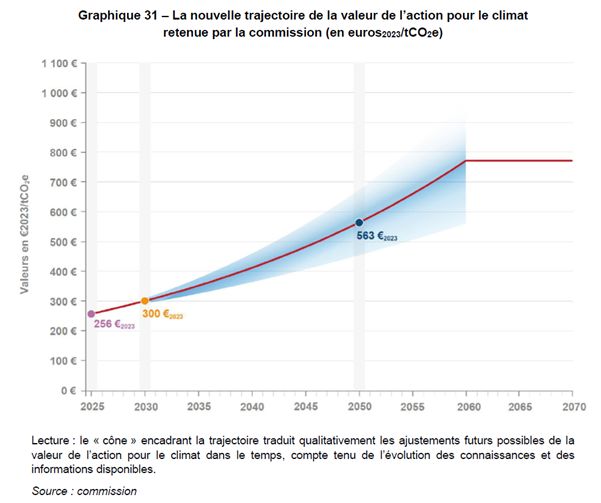
Description: The “cone” that defines the trajectory reflects potential upcoming changes in the value of the climate stock over time, in line with the latest scientific findings and available information.
References in the report to TSE's work:
- Frédéric Cherbonnier, Christian Gollier et Aude Pommeret, "Stress discounting", Journal of Risk and Uncertainty, novembre 2025.
- Cherbonnier F. et Pommeret A. (2024), "Valuing mitigation projects under uncertainty", Working Paper, Toulouse School of Economics.
- Christian Gollier, "The cost-efficiency carbon pricing puzzle", Journal of Environmental Economics and Management, vol. 128, n. 103062, November 2024.
- Christian Gollier, "The welfare cost of ignoring the beta", TSE Working Paper, n° 24-1556, juillet 2024 (Christian Gollier, “The welfare cost of ignoring the beta”, Journal of Political Economy Microeconomics, 2026, forthcoming)
- Frédéric Cherbonnier et Christian Gollier, « Fixing Our Public Discounting Systems », Annual Review of Financial Economics, vol. 15, novembre 2023, p. 147–164.
- Centre d’analyse stratégique (2011), "Le calcul du risque dans les investissements publics", rapport de la mission présidée par Christian Gollier, Paris, La Documentation française ; France Stratégie (2023), Guide de l’évaluation socioéconomique des investissements publics, op. cit.
- Frédéric Cherbonnier et Christian Gollier, "Risk-adjusted Social Discount Rates", The Energy Journal, vol. 43, n° 4, octobre 2022.
- Gollier C. (2019), "Le Climat après la fin du mois", Paris, Presses universitaires de France
Interview published in TSE Reflect, May 2026
Photos ©Pexels ©patrick lazic