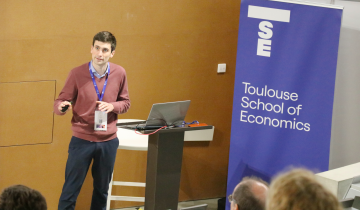
Amirreza AHMADZADEH will defend his thesis on Monday 14 September 2026 at 17:00 pm.
Title of the thesis: Trust with Evidence
Building TSE, 1 esplanade de l'université, Toulouse (Auditorium 6 and Zoom)
Supervisor: Professor Johannes HÖRNER
Memberships are:
- Johannes HÖRNER: Senior Researcher CNRS, TSE-R, Supervisor
- Thomas MARIOTTI : Senior Researcher, TSE-R, CNRS, Examinateur
- Anna SANKTJOHANSER : Assistant professor in Economics, TSE-R Examinatrice
- Marina HALAC : Professor in Economics, Yale University Rapporteure
- Andy SKRZYPACZ : Professor in Economics, Stanford UniversityRapporteur
Abstract :
This thesis studies how a principal should use costly inspection when an agent either has private information or privately decides whether to acquire it, and when the parties' preferences are misaligned. Across three chapters, it asks how commitment, monetary instruments, and the history of a relationship determine the credibility, intensity, and consequences of inspection.
The first chapter considers a static principal-agent problem without transfers. The agent privately observes his type, can reject the prescribed action ex post, and the principal may conduct a costly inspection. Under full commitment, efficient types are pooled without inspection, intermediate types face stochastic inspection and are rewarded when verification confirms a truthful report, and inefficient types are excluded. Limited commitment changes this structure asymmetrically: commitment only to actions can reproduce the optimal deterministic-inspection benchmark by making inspection sequentially credible through a self-punishing fallback action, whereas commitment only to inspection yields a lower payoff for the principal and may require the inspection of some inefficient types.
The second chapter turns from the credibility of the principal's instruments to their optimal joint design in a procurement setting. A principal combines quantities, transfers, and costly inspection to elicit the agent's private production cost. The optimal mechanism reimburses the agent for his reported production cost when no inspection occurs and concentrates information rents in bonuses paid following inspection when the agent has reported truthfully. The optimal allocation has three regions: low-cost agents produce the efficient quantity even when uninspected; intermediate-cost agents face downward quantity distortions but are inspected only with the minimum probability; and high-cost agents face both distorted quantities and more intensive inspection.
The third chapter studies how endogenous information acquisition shapes a long-run relationship. In each period, the agent must exert costly effort to learn a binary state before choosing an action, but is biased toward one action. With fixed wages, the principal disciplines the agent's information acquisition and decision-making through costly verification, workload reductions in future periods, and termination. Trust is the probability of not verifying. It builds gradually when verification confirms compliance: at low levels of trust, the principal verifies after both actions to induce effort; at higher levels of trust, verification is concentrated on the action favored by the agent, and unverified actions also affect continuation utilities in future periods. The equilibrium is therefore organized into a firing region, a verification region, and a reduced-workload region. Workload reduction is always used with positive probability: promising future relief lowers verification costs in several earlier periods, creating a snowballing effect. When the agent's bias is sufficiently strong, verification and workload relief are not enough, and even a compliant agent is eventually fired along the equilibrium path; the prospect of firing complements verification and reduces its cost.