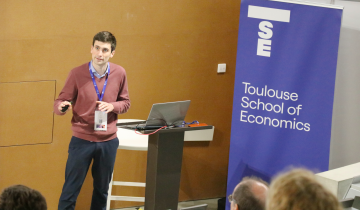
Xin ZHANG will defend her thesis on Monday 29th June 2026 at 11:00 AM (Auditorium 5, TSE Building and online)
Title: Essays in Empirical Industrial Organization: Pricing in Imperfectly Competitive Markets
Supervisor: Professor Pierre DUBOIS
To attend the conference, please contact the secretariat of the TSE Doctoral school.
Memberships are:
- Pierre DUBOIS : Professor in Economics, TSE, Université Toulouse Capitole Supervisor
- Isis DURRMEYER : Professor in Economics, TSE, Université Toulouse Capitole Co-Supervisor
- Thierry MAGNAC : Professor in Economics, TSE, Université Toulouse Capitole Examinateur
- Helena PERRONE : Associate Professor in Economics, Toulouse Business School Examinatrice
- Lionel WILNER : Senior researcher, CREST- ENSAE Paris Rapporteur
- Morten SÆTHRE : Associate Professor in Economics, Norwegian School of Economics Rapporteur
Abstract :
This dissertation consists of three essays in empirical industrial organization, each studying how prices are set and how they affect welfare in imperfectly competitive markets. The unifying theme is that understanding the welfare consequences of pricing in concentrated markets requires structural modeling to recover the underlying primitives, including preferences, costs, and entry decisions, that govern pricing behavior and its response to policy.
Chapter 1 examines the welfare effects of repealing the sales tax on feminine sanitary products using Nevada's January 2019 repeal as a natural experiment, with Utah and Arizona as control states. Using NielsenIQ retail scanner data and a difference-in-differences design, the estimated pass-through rate is approximately 77%. The repeal generated no extensive-margin response, and the total quantity of sanitary protection consumed did not increase significantly, since consumers reallocated their spending toward larger pack sizes and more expensive brands. It is consistent with a mental accounting mechanism in which households assign a fixed budget to sanitary products, informing a Constant Expenditure demand framework with multiproduct Bertrand competition. Low-income consumers are approximately 45% more price sensitive. Counterfactual simulations demonstrate that targeted subsidies dramatically outperform the tax exemption: providing low-income households with free access to products priced below $2 increases the market share by over 43 percentage points and generates consumer surplus gains nearly 44 times larger than the repeal.
Chapter 2, co-authored with Pierre Dubois and Thierry Magnac, develops a tractable structural model of consumer demand for storable goods in which forward-looking consumers stockpile during promotional periods and firms set prices endogenously in anticipation of this behavior. The model yields closed-form expressions for optimal consumption, purchases, and inventory accumulation, and is embedded in a stationary Markov equilibrium where promotional pricing arises as an equilibrium outcome rather than an exogenous feature. Estimated by indirect inference on French scanner data covering Coca-Cola purchases from 2005 to 2007, the model suggests a weekly iceberg storage cost of approximately 7.6%. Counterfactual exercises reveal that ignoring stockpiling leads a static model to systematically overestimate the price elasticity of consumption. Soda tax simulations show that the stockpiling model predicts a larger demand reduction than the no-storage benchmark since taxes erode the attractiveness of promotional prices. Moreover, cost reductions trigger disproportionately large demand responses through the stockpiling channel, while cost increases have a more muted effect.
Chapter 3, co-authored with Hanlin Zhao, investigates how the design of entry incentives shapes pharmaceutical competition and drug prices. The chapter develops a structural model of generic firms' entry decisions under the Hatch–Waxman Act, focusing on Paragraph IV patent challenges, through which generic manufacturers can enter before patent expiration by challenging secondary patents. Fixed costs of filing abbreviated new drug applications (ANDAs) are estimated using moment inequalities, ranging from $2.3 million to $16.2 million, with Paragraph IV challenges costing an additional $2.1 million on average. The results show that the 180-day exclusivity provision increases challenge rates by approximately 4 percentage points and consumer surplus by 35 percentage points. Extending exclusivity beyond 180 days further encourages challenges in previously unchallenged markets. Importantly, a uniform policy rule is suboptimal: effective exclusivity varies substantially across therapeutic classes, with a 20% challenge rate requiring roughly 2 years for antimicrobials but less than 1 year for genitourinary drugs.