Changing economic conditions have differing impacts on women’s marital outcomes and family formation in polygynous vs non-polygynous areas
Social norms and culture are crucial for economic development, and the efficacy of policy interventions may depend on the local environments in which they are enacted (Ashraf et al. 2020, Collier 2017, World Bank 2015). Across sub-Saharan Africa (SSA), marriage markets (an important determinant of household welfare) are governed by very diverse and persistent local norms regarding polygyny. This custom that allows men to simultaneously have multiple wives is still widespread in some areas, while others are essentially monogamous, as shown in Figure 1. The variation in local polygyny norms stems from several historic and slow-moving cultural/socio-economic factors (Fenske 2015, Tertilt 2005, Jacoby 1995).
Figure 1: Practice of polygyny across space in Sub-Saharan Africa
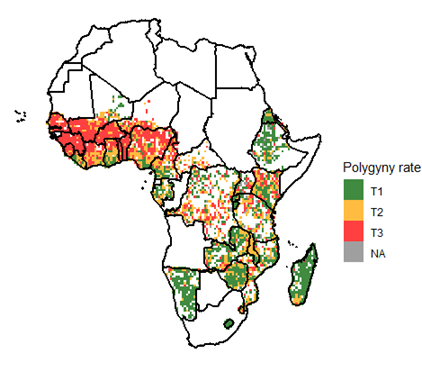
Note: Polygyny rate is the average share of women (aged 25 and older) that are in a union with a polygamous male in each 0.5 x 0.5 decimal degree grid cell (roughly 55km x 55km at the equator). It is computed from Demographic and Health Survey (DHS) data. The continuous rate is split in terciles. T1 represents grid cells with low polygyny (less than 16%), T2 is for areas with medium polygyny (between 16 and 40%), and T3 is for areas with high polygyny (more than 40%).
Bride price (payment from the groom’s family to the bride’s family at the time of marriage) is also customary in many parts of SSA, thereby making marital outcomes potentially sensitive to changes in aggregate economic conditions. In an influential paper, Corno et al. (2020) show that droughts increase child marriage (which is associated with bad health and socio-economic outcomes for women and their offspring) on average across SSA. However, their analysis assumed that marriage markets are monogamous, so it is still unclear as to how polygynous markets are affected by such economic shocks...
Illustration : Photo de Ninno JackJr sur Unsplash
References
Ashraf, N, N Bau, N Nunn, and A Voena (2020), “Bride Price and Female Education”, Journal of Political Economy 128(2): 591–641.
Atkinson, M P and B L Glass (1985), “Marital age heterogamy and homogamy, 1900 to 1980”, Journal of Marriage and the Family: 685–691.
Burke, M, E Gong, and K, Jones (2015), “Income Shocks and HIV in Africa”, Economic Journal 125(585): 1157–1189.
Cameron, L, X Meng, and D Zhang (2019), “China’s sex ratio and crime: Behavioural change or financial necessity?”, The Economic Journal 129(618): 790–820.
Carmichael, S (2011), “Marriage and power: Age at first marriage and spousal age gap in lesser developed countries”, The History of the Family 16(4): 416–436.
Collier, P (2017), “Culture, Politics, and Economic Development”, Annual Review of Political Science 20: 111–125.
Corno, L, N Hildebrandt, and A Voena (2022), “Age of Marriage, Weather Shocks, and the Direction of Marriage Payments”, Econometrica 88(3): 879–915.
Edlund, L and N P Lagerlöf (2012), “Polygyny and its discontents: Paternal age and human capital accumulation”, Columbia University Department of Economics Discussion Papers No. 1213-11.
Fenske, J (2015), “African Polygamy: Past and Present”, Journal of Development Economics 117: 58–73.
Jacoby, H G (1995), “The Economics of Polygyny in Sub-Saharan Africa: Female Productivity and the Demand for Wives in Côte d’Ivoire”, Journal of Political Economy 103(5): 938–971.
Koos, C and C Neupert-Wentz (2020), “Polygynous neighbors, excess men, and intergroup conflict in rural Africa”, Journal of Conflict Resolution 64(2-3): 402–431.
Matz, J A (2016), “Productivity, rank, and returns in polygamy”, Demography 53(5): 1319–1350.
McGuirk, E and M Burke (2020), “The economic origins of conflict in Africa”, Journal of Political Economy 128(10): 3940–3997.
Munro, A, B Kebede, M Tarazona, and A Verschoor (2019), “The lion’s share: An experimental analysis of polygamy in northern Nigeria”, Economic Development and Cultural Change 67(4): 833–861.
Rexer, J (2022), “The brides of Boko Haram: Economic shocks, marriage practices, and insurgency in Nigeria”, The Economic Journal 132(645): 1927-1977.
Reynoso, A (2019), “Polygamy, co-wives’ complementarities, and intra-household inequality”, University of Michigan Working Paper.
Tapsoba, A. (2022), “Polygyny and the Economic Determinants of Family Formation Outcomes in Sub-Saharan Africa”, TSE Working Paper No. 1240
Tertilt, M (2005), “Polygyny, fertility, and savings”, Journal of Political Economy 113(6): 1341–1371.
World Bank (2015), “World Development Report 2015: Mind, Society, and Behavior”, The World Bank.