Program Starting in September 2027
The TSE Master of Science in Finance & Data Science is designed to train a new generation of professionals capable of combining advanced financial expertise with cutting-edge data science and artificial intelligence skills.
As financial institutions increasingly rely on data-driven decision-making, machine learning techniques and quantitative analysis, the demand for graduates who can bridge finance and technology continues to grow. This program equips students with the analytical, technical and economic foundations needed to address the challenges of modern financial markets.
Combining rigorous academic training with practical applications, the program covers quantitative finance, financial data analytics, machine learning, risk management and macro-finance. Students develop both theoretical knowledge and hands-on experience through applied projects and close interactions with industry professionals.
Supported by internationally recognized faculty and strong partnerships with financial institutions, central banks, regulators and fintech companies, the program offers a unique learning environment at the intersection of finance and data science.
Students can tailor their academic journey through specialized courses in Finance, Macro-Finance or Data Science, allowing them to align their studies with their career ambitions. Graduates are prepared for high-impact positions in banking, asset management, fintech, consulting, regulatory institutions and international organizations.
Why choose this program?
- Unique integration of Finance and Data Science
- Rare Macro-Finance track in Europe
- Strong focus on AI and LLM applications to finance
- Alignment with CFA and FRM certifications
- Backed by renowned international faculty
- Strong research partnerships with financial institutions and central banks
- Practical company project: group work with partner companies
- Industry exposure : conferences and study trips to major financial centers


Program - 60 Credits
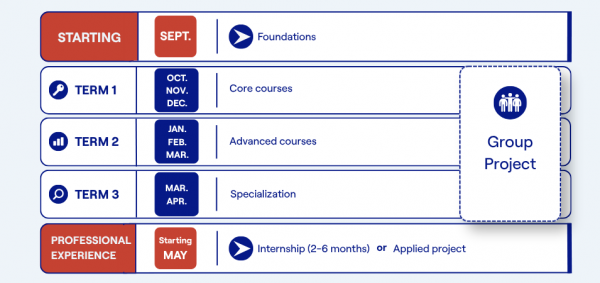
FoUndations (3 optional courses: 21 h, no credit) |
|---|
|
Term 1 (4 courses: 27h + 12h of tutorials, 4 credits each) |
|---|
|
Term 2 (4 out of 5 courses: 27h + 12h of tutorials, 4 credits each) |
|---|
Choose 4 out of 5 |
|
|
Term 3 (5 courses: 15h, 3 credits each) |
||
|---|---|---|
Elective courses |
||
|
Finance |
Macro-Finance |
Data Science |
|
|
|
Group Project (September - April, 3 credits) |
Internship or Applied Project (2–6 months, 10 credits) |
|---|
Teaching
The Master in Finance & Data Science combines rigorous training in finance, economics, statistics, machine learning, and data analytics to prepare students for data-driven careers in the financial sector. Teaching is directly informed by the latest advances in research and industry practices, ensuring that students acquire both strong theoretical foundations and practical analytical skills.
Through a curriculum grounded in quantitative methods, financial modelling, programming, and data analysis, students learn how to extract insights from complex datasets, assess financial risks, develop predictive models, and support decision-making in rapidly evolving financial environments.
Excellence of the Faculty
Ranked among the world's leading economics institutions in the RePEc bibliographic rankings, TSE brings together internationally renowned scholars whose expertise spans finance, econometrics, machine learning, and data science. Their research contributes to advancing knowledge in areas such as financial markets, risk management, asset pricing, artificial intelligence, and data-driven decision-making.
By learning from faculty members actively engaged in cutting-edge research, students gain direct exposure to the latest methodologies and analytical tools used in academia, financial institutions, consulting firms, and technology-driven industries. This close integration of research and teaching ensures that the programme remains at the forefront of developments in both finance and data science.
Meet some of our faculty members
Jean Tirole
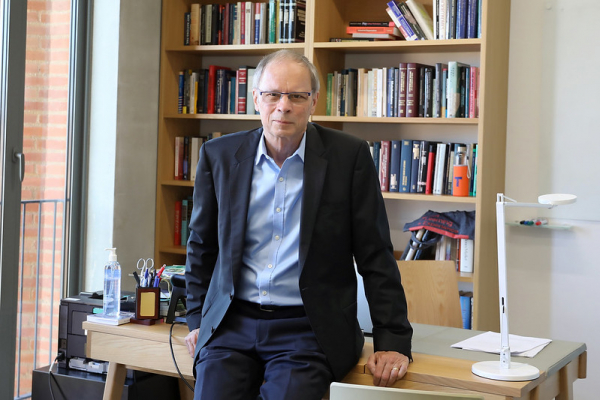
Jean Tirole is a Professor of Economics and a leading figure in modern economic theory and 2014 Nobel prize in economics. His research spans industrial organization, regulation, finance, macroeconomics and banking, as well as behavioral and psychology-based economics. He has made major contributions to the understanding of market power, regulatory design, and the functioning of financial systems. He has published over 200 articles in leading international journals and authored numerous influential books, including Economics for the Common Good, which brought economic insights to a broader audience.
Christian Gollier
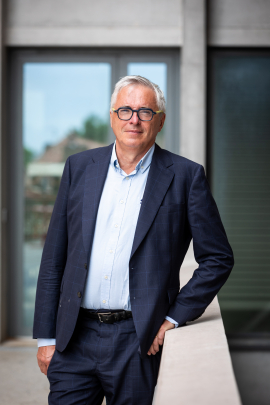
Internationally renowned economist specializing in decision-making under uncertainty, his research focuses on risk, savings, insurance, finance, sustainable development, and the links between economics and psychology. He has published 10 books on risk, including "The Economics of Risk and Time" (MIT Press) and has received numerous scientific distinctions. He contributed to the 2007 Intergovernmental Panel on Climate Change (IPCC) report, awarded the Nobel Peace Prize that same year.
Jean-Charles Rochet
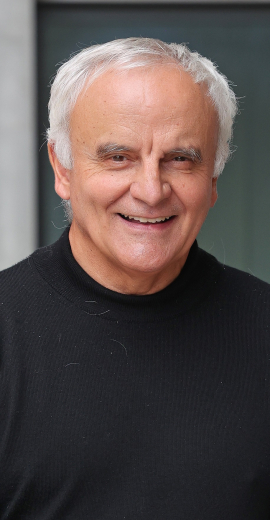
Jean‑Charles Rochet is Professor of Economics and holds a PhD in mathematical economics from the University of Paris. He has taught at the Universities of Geneva and Zurich, the London School of Economics, and MIT Sloan, and has collaborated with leading universities and central banks worldwide, including the New York Fed and the Bank of Japan. He served as Vice‑Chairman of the European Systemic Risk Board and has been a member of the BIS Scientific Committee. President of the Econometric Society in 2012, He has published over 100 articles and 7 books. His research interests include banking, digital money, financial stability, industrial organization and contract theory
René Garcia
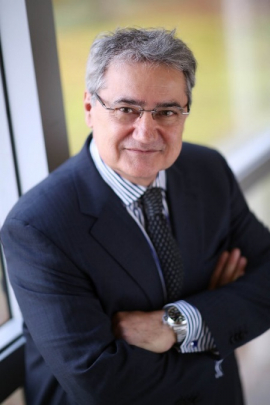
René Garcia is an economist trained at ESSEC Business School, the Université de Montréal (Master’s degree), and Princeton University (Ph.D.). He spent most of his career at the Université de Montréal, where he taught econometrics and finance from 1991 to 2007 and again from 2016 to 2024, and now holds the title of Emeritus Professor. From 2007 to 2015, he was Chair Professor of Finance at EDHEC Business School. He also held a Research Fellowship at the Bank of Canada.
A recognized specialist in empirical finance and econometrics, his research focuses on asset pricing, portfolio management, risk, and nonlinear models. Highly committed to teaching, he has contributed to the creation of innovative graduate programs in finance. He is the recipient of the Gérard-Parizeau Award (2023) and co-founder of the Journal of Financial Econometrics.
The Master of Science in Finance & Data Science is designed for highly motivated students with strong quantitative and analytical skills who wish to develop expertise at the intersection of finance, data science and artificial intelligence.
Target Profile
French M1 level or equivalent in Economics, Mathematics, Statistics, Engineering, Computer Science, Physics,...
As the program is taught 100% in English, applicants are expected to demonstrate a strong command of the English language (TOEFL iBT 95/120 or 5/6 at "Best Scores", IELTS Academic and One Skill Retake 7/9 minimum or Cambridge English Advanced Certificate level C1, Home or Center Edition).
Admission Calendar
Three application rounds: October-November, February, May (more details will follow).
Tuition Fees
€22,500
Merit-based scholarships are possible.
Contacts
More information about applications: admissions@tse-fr.eu
Career Support
TSE supports students in preparing for successful careers through dedicated professional development workshops, including CV and cover letter reviews, career coaching, and employability training. Students also receive guidance in securing internships in France or abroad, with access to opportunities through the TSE Alumni & Community network.
The study trip aims to introduce students to companies and key financial decision‑making institutions.
Throughout the year, career fairs, networking events, and the annual Business Networking Day connect students with employers, public institutions, and alumni. The Campus Talks series further enriches the student experience by bringing professionals, alumni, and researchers to campus to share insights and career advice.
Career Path
This programs trains highly sought-after technical experts in financial institutions, central banks, regulators, fintechs, consulting and international organizations:
- Finance: Quantitative Analyst, Risk Manager, Investment Analyst, Portfolio Manager, Financial Engineer, Trading & Structured Products Analyst...
- Macro-Finance: Financial Stability Analyst, Macro-Finance Researcher, Prudential Regulation Specialist, Monetary Policy Analyst, Economic & Financial Policy Advisor, Compliance & Risk Manager...
- Data Science: Data Scientist, Machine Learning Engineer in Finance, Fintech Analyst, Risk Modeling Specialist, Big Data, Analyst, Risk Manager...
As a TSE alumnus working in the banking sector, I’ve noticed that the demand for professionals who are proficient in both finance and data science has never been greater. The focus of this master’s program fully addresses this structural transformation of the industry. TSE is particularly well-positioned to train these professionals, thanks to the excellence of its faculty and its strong foundation in quantitative economics, which provided me with a solid foundation for analyzing these developments.
Clémentine Gallès, Class of 2003 - Chief Economist and Strategist at Societe Generale Private Banking


TSE was transformative for me.
The constant exchange between leading academics, industry practitioners, and an international student community created an environment where rigorous theory met real-world application.
As finance becomes increasingly driven by data and AI, TSE is uniquely positioned to equip graduates with the quantitative, technical, and strategic skills that employers across the financial sector are seeking.
Juan David Gomez, Class of 2014 - Head of Asset Liability Management at IDB Invest
What makes this program particularly attractive is its unique combination of skills developed within TSE’s academically rigorous environment.
It builds on strong foundations in economics and finance while equipping students with essential quantitative, computational, and data science tools. As a TSE alumnus, I benefited from training in financial markets and intermediation, which prepared me for roles in central banking, including policy economist and risk manager positions. This blend of rigorous economic training and advanced data science is highly valued by recruiters. It enables graduates to pursue diverse careers, from quantitative finance and risk management to monetary policy, regulation, and fintech innovation.
Adina Fudulache, Class of 2014 - Economist at the European Central Bank