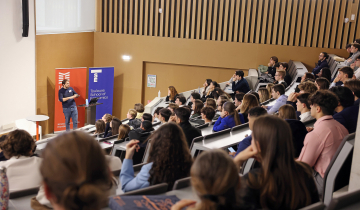
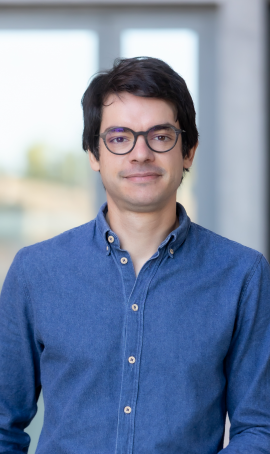
Victor Gay will defend his HDR (habilitation à diriger des recherches) on Thursday 18 June at 14:00, Auditorium 5 and by ZOOM
"Essays in Economic History and Political Economy"
To attend the conference, please contact the secretariat Christelle Fotso Tatchum.
Memberships are:
- Paul SEABRIGHT : Professor in Economics, Université Toulouse Capitole Professor referee
- Pauline GROSJEAN : Professor in Economics, University of New South Wales Examinatrice
- Julia CAGE : Professor in Economics, Université Sciences Po Paris Rapporteure
- Mara SQUICCIARINI : Associate Professor in Economics, Bocconi University Rapporteure
- Claude DIEBOLT : Senior Researcher, CNRS-Université de Strasbourg Rapporteur
Abstract
My research investigates processes of social change through the lenses of economics and history. My doctoral research focused on the origins and long-run evolution of gender norms, with a particular emphasis on women’s labor force participation. I have pursued this agenda along two main lines. First, I studied female labor dynamics in twentieth-century France, using the First World War as a historical natural experiment (Boehnke and Gay, 2022; Gay, 2023a; Gay and Grosjean, 2023). Second, I investigated whether linguistic structures shape gender gaps in economic behavior (Gay et al., 2013a; 2013b; 2016a; 2016b; 2018).
My postdoctoral research shifted both period and focus, turning to state-building in Ancien Régime France and its consequences for social conflict (Albertus and Gay, 2025; Gay, 2025a) and demographic change in the run-up to the French Revolution (Gay, Gobbi, and Goñi, 2024a; 2024b; 2025). This body of work draws on my five-year interdisciplinary grant, ObARDI (ANR-20-CE38-0015, 2021–26), which aims to deepen our understanding of the construction of the early modern state (Gay and Poublanc, 2022).
Beyond these substantive research themes, a common thread in my work is a methodological focus on reproducibility (e.g., Gay, 2023b) and data curation (e.g., Gay, 2021; Gay, 2025b). It is also defined by a strongly interdisciplinary orientation, drawing on approaches from fields beyond economics, including history, political science, demography, geography, sociology, and computer science (e.g., Bourel et al., 2022; Dazey and Gay, 2025; Gay and Poublanc, 2023). These different strands also structure my ongoing research, a substantial part of which uses the First World War as a revealing case through which to study how critical junctures reshape societies in both economic and political terms.