
Training Tomorrow’s Leaders to Tackle Major Economic and Societal Challenges
The TSE Master of Science program aims to train high-level professionals, with advanced skills in quantitative methods, economic analysis, and behavioral science, who will be capable of comprehensively addressing—from design to communication—the complex problems that economic actors face today and will face in the future. Particular attention is paid to quantitative methods applied to the humanities and social sciences: knowing how to leverage the ever-growing volume of data to inform or support economic or social decisions, while ensuring their acceptability, is essential.
Graduates are equipped to meet the current and future needs of economic actors in a changing world, where the abundance of data, digitalization and the development of artificial intelligence, as well as the climate transition, are transforming economic models of businesses (start-ups or established firms) and public authorities. These transformations require an understanding of the mechanisms driving them and their impact on both people’s circumstances and business practices, and call for leaders with a holistic approach to these issues, guided by a commitment to the common good.

At Toulouse School of Economics, we see economics as a driving force for the common good. We believe in building bridges and nurturing collective thinking. Discover our vision.

The TSE Master of Science programme in a few words:
- A program taught entirely in English
- A teaching approach combining research-based learning and experiential learning
- An international outlook with diverse cohorts and a wide range of study abroad opportunities
- 90% of graduates employed within six months after graduation
- A two-year program awarding a grade of Master, acredited by the French Ministry of Higher Education
- Teaching delivered by world-class academic researchers and industry professionals
See also
General structure of the programme
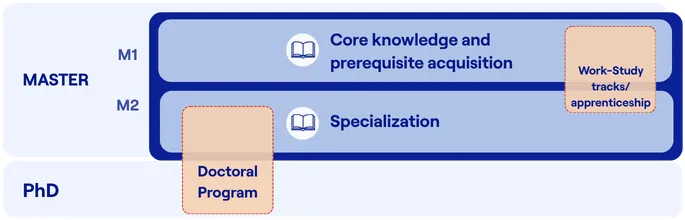
The TSE Master of Science is designed to offer students flexibility in their choices and the opportunity to tailor their course of study, with a progressive specialization. Students are guided in their choices by prerequisites and course options that ensure the coherence of their academic program.
September 2027 Intake
During the M1 year, students select courses that enable them to acquire the core knowledge and prerequisites required to enter one of the specialization tracks in the M2 year. Please refer to the M2 curriculum for the prerequisites specific to each specialization.
Students benefit from:
- Career development support, through dedicated professional development modules, participation in the Business Networking Day, and conferences held on campus;
- A personalized study plan, with a wide range of elective courses allowing students to tailor the program to their academic interests and career goals.
M1 : Core knowledge and prerequisite acquisition
► Starting in September 2027
During the M1 year, students build their course programme based on their plans for specialization in the M2 year.
Students construct their curriculum by choosing blocks of subject-specific courses in Economics (Macroeconomics, Game Theory, Public Economics, Industrial Organisation, etc.), Econometrics (Intermediate Econometrics, Program Evaluation, etc.), Statistics (Probability and Statistics for Data Science, Foundations of Machine Learning, Topics in AI), Mathematics (Analysis, Markov Chains, Martingales, Optimization for Machine Learning, etc.), Finance (Market Finance, Corporate Finance) and Law. Combinations of these courses allow students to acquire the prerequisites required for the various specialization tracks offered in the M2 year.
The program also includes a transversal course in Contract Theory and Incentives, an empirical project in Applied Econometrics, a student-life project, as well as modules in programming and professional development. From April onwards, students undertake either a professional internship or a preparatory course for the doctoral programme (advanced courses and a research internship with the production of a dissertation).
A two-year work-study programme (with some courses taught in French) is also available in the M1 and M2 years, with two possible pathways: Applied Economics (AE) and Econometrics and Statistics (ES).
M2: Specialization
► Starting in September 2028
During the M2 year, students choose a specialization track, enabling them to consolidate the knowledge and skills associated with specific professions and sectors. The specializations offered to students are subject to the successful completion of the relevant prerequisites during the M1 year.
The available specializations are inspired by the school’s existing Master’s programs, which have gained recognition within the professional world: Economics of Markets and Organizations (EMO), Economics of Competition Law (ECL) – a dual degree in economics and law, Public Policy and Development (PPD), Environmental Economics and Policy (EEP), Econometrics and Empirical Economics (EEE), Economics of Global Risks (EGR), Data Science for Social Sciences (D3S), and Mathematics and Economic Decision (MED).
Each specialization offers a set of modules, some of which are shared across several specialisations, providing students with flexibility in their course choices. The specialisations involve professionals and develop experiential learning activities (case studies, projects), including a year-long project, which may take the form of a supervised project led by a lecturer-researcher or a professional, or a project carried out in partnership with a company or institution. The student’s programme is supplemented by modules in programming for data analysis and professional development modules. From April onwards, the student undertakes an internship in a professional setting.
Two specializations correspond to the first year of TSE’s doctoral track:
- Doctoral track in Economics: specialization in Economic Theory and Econometrics (ETE)
- Doctoral track in Applied Mathematics and Statistics: specialization in Mathematics and Economic Decision (MED)
Students undertake research training courses offered within each programme and produce a research dissertation, supervised by a TSE researcher.
Students can also complete their final year by taking courses in Finance, enabling them to obtain the associated diploma and the TSE Master of Science. These include the Master’s in Finance at the Toulouse School of Management (TSM) and the Master of Science in Finance and Data Science, a one-year specialised programme scheduled to launch in the 2027 academic year.
See also
The School implements numerous initiatives to strengthen connections between students and the professional world, promoting access to employment.
A wide range of career opportunities is available, depending on the pathways chosen by students.
Our graduates integrate easily into the job market. They hold senior management positions in banking, insurance, consultancy, and within international institutions. Public administrations and market regulation authorities also offer career opportunities as economists, legal economist, analysts, data scientists, and consultants.
Finally, TSE also opens pathways to careers in public and private research.
Visit the YouTube TSE Careers / Alumni Channel to watch testimonials from graduates about their professions and career paths.
See also
As a program of excellence, the TSE Master of Science is aimed at students who have completed three years of higher education and possess a strong foundation in Economics and Mathematics.
This program requires a strong work ethic and organizational skills in order to maximize the chances of success and make informed choices among the various pathways offered.
Through this degree, TSE aims to attract highly talented students; selection is therefore based exclusively on academic criteria.
Applications to M1 year (from the 2027–2028 academic year) and to M2 year (from the 2028–2029 academic year)
Entry into M1 year is based on the following prerequisites:
- Bachelor’s degree (3–4 years)
- Strong quantitative background
- English proficiency (C1)
- Applications will open in November 2026 (More information coming soon on the M1 year webpage)
Direct applications to the M2 year of the TSE Master of Science are reserved for students who have sufficient academic background to successfully complete the chosen program. In 2027-2028, students apply to the existing Master program (refer to the International Master’s track program).
See also
On 16 December 2025, the School’s Board of Governors adopted the fee policy for the TSE Master of Science.
This tuition fee policy will apply from the start of the 2026–2027 academic year to students joining the programme.. It establishes specific tuition fees reflecting the cost of the program and associated services, and is divided into two categories: “means-tested tuition fees” (for European students) and “flat-rate tuition fees” (for non-European students).
General Principles
Tuition fees are €12,000 per year for students who enter the program in M1 year or M2 year.
Students from the European Economic Area benefit from fee modulation based on income and family situation.
TSE offers merit-based scholarships covering part or all of the tuition.
Other scholarships are available: Eiffel scholarship, Lafayette, ANITI, Jean-Jacques Laffont scholarship, and TSH-Talent Foundation.
Means-Tested Tuition Fees: European Students
Means-tested tuition fees apply to students registering for the TSE Master of Science as part of their initial training (excluding distance learning) whose tax residence is within the European Economic Area (EEA). This modulation is a principle designed to adjust the cost of tuition to reflect the standard of living of the household to which the student belongs.
The calculation of the standard of living takes into account:
- All income received (salaries and professional income, property income, pensions, etc.) by the student’s parents for the year N-2 (where N represents the academic year of registration);
- The number of consumption units in the student’s household (1 unit for the first adult in the household, 0.5 for other persons aged 14 or over, and 0.3 per child under 14).
The standard of living is calculated by dividing total income by the number of consumption units. The scales detailed in Appendix 1 of the Board of Directors’ resolution specify the amounts allocated to the standards of living calculated in this way. In practice, this adjustment allows for reductions of up to €11,500 in M1 and M2 years.
Access the calculator to estimate your tuition fees
Flat-Rate Tuition Fees: Non-European students
Flat-rate fees apply to students whose tax residence is outside the European Economic Area (see Article 5 of the Board of Governors’ resolution for the conditions governing the application of flat-rate fees).
The amounts of the flat-rate fees for each year is €12,000.
- Students receiving grants from the CROUS or the French Government, wards of the Nation, and beneficiaries of OFPRA status are exempt from tuition fees.
- Students enrolled in a work-study program (apprenticeship) during their M1 and M2 years have their tuition fees covered by their host company.
- TSE is developing a policy of academic excellence by awarding merit-based scholarships to cover all or part of students’ tuition fees. Scholarships are awarded as part of the application process.
See also
| Questions | Answers |
|---|---|
| Is it possible to join the TSE Master of Science programme at any stage? | It is possible to join the programme in M1 year or M2 year through a parallel admission process. Successful completion of the third year leads to the awarding of the TSE Master of Science degree. An external student joining the programme in M1 year or M2 year will be required to pay tuition fees of up to €12,000 (depending on the application of means-tested modulations). They must also demonstrate a C1 level of English. |
| If I have to repeat a year due to circumstances beyond my control whilst studying for the TSE Master of Science programme, will I have to pay the tuition fees again? | Requests to repeat a year due to circumstances beyond the student’s control are assessed on a case-by-case basis and may, where appropriate, result in a partial exemption from tuition fees. |
| What new features will be offered as part of the TSE Master of Science programme? |
|
| I am a citizen of the European Economic Area, but I am not financially dependent on my parents’ household. How will my modulated tuition fees be calculated? | This is a special case; further details and procedures will be available online shortly. |
| As students cannot repeat a year within the TSE Master of Science programme, what options are available to students who have not successfully completed the first year (Y1)? | The selection process for entry into the first year of the programme is designed to ensure that students have a sufficiently strong academic foundation to support their success throughout the course. Any instances of failure will be analysed to identify the causes and provide support to the students concerned. |
| What changes will there be to the current Master’s programmes with the introduction of the TSE Master of Science programme? | The current Master’s programmes, both standard and international, will evolve as the TSE Master of Science programme is gradually implemented. In 2027–2028, the M1 year of the degree will be introduced, offering modules that enable students to tailor their course of study with a view to specialising in the third year. From the start of the 2028–2029 academic year, the M2 year of the TSE Master of Science will be introduced. The specialisations offered will cover the current Master’s programmes. The degree will also offer a work-study programme across two tracks, during M1 year and M2 year. |
| What level of English is required for the TSE Master of Science programme? | In order to obtain the TSE Master of Science degree, students must achieve a C1 level in English. For students entering the programme in the M1 year or M2 year of the school cycle, this requirement must be met upon admission. |
| Can I go on to do a PhD after completing the TSE Master of Science? | TSE’s doctoral programmes are linked to the TSE Master of Science programme. Furthermore, as completion of this programme confers a Master’s degree, it enables holders to apply for doctoral programmes at other institutions. |
| Does the TSE Master of Science programme offer a research specialisation for those wishing to pursue a PhD? | The research specialisation is offered in the M2 year of the TSE Master of Science programme, within doctoral programmes in Economics (Economic Theory and Econometrics specialisation) and in Applied Mathematics and Statistics (Mathematics and Economic Decision-Making specialisation). |
| Are the dual-degree programmes still available with the TSE Master of Science? | The relevant tracks of the TSE Master of Science programme continue to offer the option of a dual degree with a Master’s degree in Business Law (M2 year, Economics and Competition Law specialisation). |
| What new career opportunities or roles are available to graduates of the TSE Master of Science programme? | The TSE Master of Science programme is designed to prepare students for the careers of the future, including roles involving significant responsibility and senior management positions. It aims to equip students with the ability to think strategically and analytically, enabling them to adapt swiftly to a constantly changing professional environment. Career opportunities are detailed on the programme’s webpage. |