
Introduction
Starting in the program from September 2027
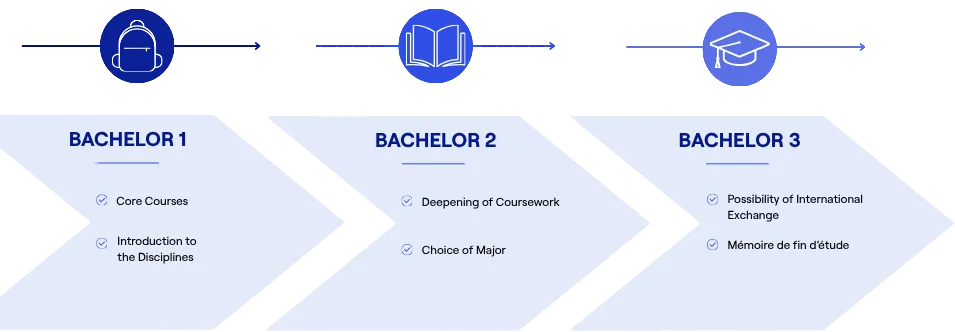
The TSE Bachelor is a selective three-year program that integrates quantitative methods, economics and quantitative social sciences, as well as mathematics. It aims to train undergraduate students who will continue their studies through to a master's degree, either within TSE's own program the TSE Master of Science or in other master's programs.
Who is the Bachelor's program for?
It is designed for students interested in economics and/or quantitative social sciences, who have an aptitude for quantitative reasoning (data analysis, applied mathematics).
A flexible, customizable curriculum
The program is built around disciplinary majors and minors offered by TSE's departments, which students can combine to design their own course of study.
A hands-on approach to learning
Within this flexible program, the emphasis is on experiential learning, through which students gain knowledge and develop problem-solving, teamwork, and communication skills by engaging in applied work, group projects, and challenges.
An international outlook
Courses are taught in English by faculty recruited internationally. Students are recruited from around the world, contributing to the campus's cosmopolitan character.
Students can spend part of their third year abroad through a degree-granting exchange at one of the school's many partner universities.
Students may also take a gap year between their second and third year to study abroad, complete an internship, or pursue a personal project (such as volunteering with an association or working abroad).
Why Choose the TSE Bachelor?
See also
Program Structure
Organization of the Academic Year
The academic year is divided into four eight-week periods, preceded by an orientation/integration period and rounded out by a dedicated week for special activities (career preparation, data challenge, etc.). This structure allows for steady, consistent progress in learning throughout the three years of the Bachelor's program.
| Integration | 31 august - 13 september | 2 weeks: cross-disciplinary activities |
|---|---|---|
| Period 1 | 14 september- 15 november | 8 weeks of classes + 1 week vacation (Toussaint) |
| Period 2 | 16 november - 24 january | 8 weeks of classes + 1 week vacation (Christmast) |
| Special Activities | 25 january - 31 january | Career preparation, data challenge, etc |
| Period 3 | 1er febuary – 4 april | 8 weeks of classes + 1 week vacation (winter) |
| Period 4 | 5 april - 6 June | 8 weeks of classes + 1 week vacation (spring) |
Course of Study
Core Curriculum in Quantitative Methods
From the first year onward, all students follow a core curriculum in quantitative methods, which forms the scientific foundation of the Bachelor's program. It provides the knowledge and skills needed to conduct model-and data-based analysis. It offers courses over the 3 years in the following areas:
- Data Science (statistics and econometrics): 6 courses (36 credits)
- Computer Science and data applications: 4 courses (24 credits)
- Mathematics: 4 courses (24 credits)
Foundational Courses
In the first year, students also take common courses in the following areas:
- Economics: 2 courses (12 credits)
- Quantitative social sciences: 2 courses (12 credits)
Major
In the second year, students choose a major in economics, quantitative social sciences, or mathematics. A major consists of 8 courses (48 credits) plus a capstone thesis (6 credits) completed in the final year. Given the courses already taken in the core curriculum and foundational courses, students take 6 courses (36 credits) during years 2 and 3 to complete the major.
Elective Courses
Students round out their course of study by freely choosing elective courses. Students may pursue a minor by selecting the corresponding 4 courses (24 credits). Students may pursue a second major by selecting the corresponding courses (48 credits).
See also
Course Offerings
Quantitative Methods
The core curriculum in quantitative methods provides students with the knowledge and skills needed to conduct model- and data-based analysis across the various fields offered as majors and minors in the program. It consists of courses covering the following areas:
- Data Science (statistics and econometrics)
- Computer Science and data applications
- Mathematics
Name
|
Credits
|
Period
|
Open to students in
|
Open
|
||
B1
|
B2
|
B3
|
||||
| Calculus 1 |
6 |
1-2 |
X |
2027-2028 | ||
| Linear algebra |
6 |
3-4 |
X |
2027-2028 | ||
| Calculus 2 |
6 |
1-2 |
X |
2028-2029 | ||
| Probability |
6 |
3-4 |
X |
2028-2029 | ||
| Introduction to QSS methods |
6 |
1-2 |
X |
2027-2028 | ||
| Statistics |
6 |
3-4 |
X |
2027-2028 | ||
| Regression 1 |
6 |
1-2 |
X |
2028-2029 | ||
| Regression 2 |
6 |
3-4 |
X |
2028-2029 | ||
| Topics in data science |
6 |
1-2 |
X |
2029-2030 | ||
| Advanced topics in data science |
6 |
3-4 |
X |
2029-2030 | ||
| Statistical computing 1 |
6 |
1-2 |
X |
2027-2028 | ||
| Games and experiments |
6 |
3-4 |
X |
2027-2028 | ||
| Statistical computing 2 |
6 |
1 |
X |
2028-2029 | ||
| Statistical computing 3 |
6 |
3 |
X |
2028-2029 | ||
| Data visualization |
6 |
1 |
X |
2029-2030 | ||
| Data writing and presenting |
6 |
3 |
X |
2029-2030 | ||
Economics
Economics courses enable students to conduct economic analysis by exposing them to the key questions and methods of the field. In the early years, the program offers courses in microeconomics and macroeconomics that provide the foundations of economic analysis. Following these courses, students are offered courses in public economics, industrial organization, as well as other courses in specific fields (environmental economics, etc.).
The economics track offers both a major and a minor.
Earning a major in economics provides the prerequisites needed to pursue graduate studies in economics at the master's level.
Name
|
Credits
|
Period
|
Open to students in
|
Open
|
Counts toward the minor
|
Counts toward the major
|
||
B1
|
B2
|
B3
|
||||||
| Principales of Economics |
6 |
1-2 |
X |
2027-2028 | ECO - Obligatoire* | ECO - Obligatoire* | ||
| Introductory Microeconomics |
6 |
3-4 |
X |
2027-2028 | ECO - Obligatoire* | ECO - Obligatoire* | ||
| Introductory Macroeconomics |
6 |
1-2 |
X |
2028-2029 | ECO - Obligatoire | ECO - Obligatoire | ||
| Introductory Microeconomics |
6 |
3-4 |
X |
2028-2029 | ECO - Optionnel | ECO - Obligatoire | ||
| Introductory Macroeconomics |
6 |
1-2 |
X |
2029-2030 | ECO - Optionnel | ECO - Obligatoire | ||
| Industrial Organization |
6 |
3-4 |
X |
2029-2030 | ECO - Optionnel | ECO - Obligatoire | ||
| Climate, Environment and Public Economics |
6 |
1-2 |
X |
2029-2030 | ECO - Optionnel | ECO - Obligatoire | ||
| Trade and Growth |
6 |
3-4 |
X |
2029-2030 | ECO - Optionnel | ECO - Obligatoire | ||
| *Cour Obligatoire pour tous les étudiants | ||||||||
Quantitative Social Sciences
Courses in quantitative social sciences give students the skills and know-how needed to understand and address complex societal challenges through the lens of several disciplines: political science, sociology, psychology, and anthropology. The program emphasizes evidence-based decision-making and solving real-world problems by taking into account the many factors that influence human decision-making and behavior. Through hands-on projects, interdisciplinary courses, study-abroad opportunities, and learning-by-doing experiences, students learn to turn data into useful knowledge to inform government policy, businesses, non-governmental organizations, and society at large.
The quantitative social sciences track offers both a major and a minor.
For students who wish to enter specialized master's programs in the social sciences that require courses not offered within the QSS major, specific study-abroad opportunities will be made available to them during the third year. Through these partnerships, students can earn a minor in political science, sociology, anthropology, or psychology (a minor corresponds to a total of four courses).
Name
|
Credits
|
Period
|
Open to students in
|
Open
|
Counts toward the minor
|
Counts toward the major
|
||
B1
|
B2
|
B3
|
||||||
| Political Science |
6 |
1-2 |
X |
X |
2027-2028 | ECO - Optionnel* | ECO - Obligatoire** | |
| Sociology |
6 |
1-2 |
X |
X |
2027-2028 | ECO - Optionnel* | ECO - Obligatoire** | |
| Psychology |
6 |
3-4 |
X |
X |
2027-2028 | ECO - Optionnel* | ECO - Obligatoire** | |
| Anthropology & Human Biology |
6 |
3-4 |
X |
2028-2029 | ECO - Optionnel* | ECO - Obligatoire** | ||
| Political Economy of high income Societies |
3 |
1 |
X |
X |
2029-2030 | ECO - Optionnel | ECO - Obligatoire | |
| Why we get sick |
3 |
1 |
X |
X |
2029-2030 | ECO - Optionnel | ECO - Obligatoire | |
| Human Welfare in Low-income Societies |
3 |
2 |
X |
X |
2029-2030 | ECO - Optionnel | ECO - Obligatoire | |
| What health interventions work ? |
3 |
2 |
X |
X |
2029-2030 | ECO - Optionnel | ECO - Obligatoire | |
| Social influences on Behavior |
3 |
3 |
X |
X |
2029-2030 | ECO - Optionnel | ECO - Obligatoire | |
| TBD |
3 |
3 |
X |
X |
2029-2030 | ECO - Optionnel | ECO - Obligatoire | |
| Network Theory and Analysis |
3 |
4 |
X |
X |
2029-2030 | ECO - Optionnel | ECO - Obligatoire | |
| Norms, Networks and Environmental Behavior |
3 |
4 |
X |
X |
2029-2030 | ECO - Optionnel | ECO - Obligatoire | |
|
*Les étudiants doivent suivre au moins 2 cours de niveau 1 pour valider une mineure **Il est obligatoire de suivre 2 de ces cours au cours de la première année |
||||||||
Mathematics
The mathematics program gives students a solid foundation in core mathematical tools, including differential and integral calculus, linear algebra, probability, and basic statistical reasoning. These courses are designed to support the quantitative components of the program and to provide the mathematical language and tools needed in economics, social sciences, data science, econometrics, and related fields.
The mathematics track offers both a major and a minor.
Students who choose the mathematics major can deepen their training through more advanced courses such as real analysis, advanced linear algebra, measure theory and probability, optimization, and differential equations. These courses provide rigorous preparation for pursuing graduate studies in applied mathematics and data science.
Name
|
Credits
|
Period
|
Open to students in
|
Open
|
Counts toward the minor
|
Counts toward the major
|
||
B1
|
B2
|
B3
|
||||||
| Real analysis 1 |
6 |
1-2 |
X |
2028-2029 | MAT - Obligatoire | MAT - Obligatoire | ||
| Advanced linear algebra |
6 |
1-2 |
X |
2028-2029 | MAT - Obligatoire | MAT - Obligatoire | ||
| Real analysis 2 |
6 |
2-3 |
X |
2028-2029 | ECO - Optionnel | MAT - Obligatoire | ||
| Measure theory and probability |
6 |
1-2 |
X |
2029-2030 | ECO - Optionnel | MAT - Obligatoire | ||
| Optimization |
3 |
3-4 |
X |
2029-2030 | ECO - Optionnel | MAT - Obligatoire | ||
| Differential equations |
3 |
1-2 |
X |
2029-2030 | ECO - Optionnel | MAT - Obligatoire | ||
See also
Admission
Candidate Profile
The program is open to students who have completed high school and is designed for those interested in quantitative methods, economics, and quantitative social sciences.
Admissions Calendar
Applications may be submitted through the national Parcoursup application process starting in January 2027.
TSE will conduct a separate campaign for international students. More information will be available in October 2026.
Fees
The tuition policy for the TSE Bachelor of Science program will be finalized in early October 2026. A merit-based scholarship program will be included.
See also
What Comes Next?
The Bachelor's: The First Step Toward an Ambitious Career
The Bachelor's program will enable students to pursue careers (consultant, data analyst, statistician, economist, policy advisor, etc.) in the private sector (consulting, digital platforms, market and opinion research firms, etc.), within governmental or non-governmental organizations, or in higher education and research, after completing a master's degree.
Graduates will find opportunities in fields where they will need advanced tools for generating, analyzing, and interpreting data. Bachelor's students will benefit from rigorous, coherent training in quantitative methods. They will also benefit from an interdisciplinary approach focused on strong foundational training and the application of quantitative methods to the diverse types of data they will encounter in their careers. Students will be equipped to take into account the economic, social, psychological, political, and other factors that influence the behavior of individuals, businesses, and governments.
Continuing Studies After the Bachelor's
To reach these careers, the TSE Bachelor prepares students to pursue master's-level studies, either within TSE's own program the TSE Master of Science or at other institutions in France and abroad.
The choice of major, elective courses, and an optional minor allows students to progressively shape their plans for further study.
Depending on their track, students will be able to apply to various master's programs offered by TSE or other institutions, particularly in economics, data science, finance, public policy, or applied mathematics. Admission to the TSE Master of Science remains subject to that program's own specific criteria.
Continuing Studies After a Major in Economics
This major provides the most natural preparation for continuing on to master's-level studies in economics.
At TSE, further study can take place within the TSE Master of Science, with a view to choosing a specialization oriented toward economics or data science: Economics of Markets and Organizations (EMO), Public Policy and Development (PPD), Environmental Economics and Policy (EEP), Econometrics and Empirical Economics (EEE), Economics of Global Risks (EGR), Applied Economics (EA), Data Science for Social Sciences (D3S). Specific finance programs are also accessible: the M2 Finance from Toulouse School of Management and the Master of Science in Finance and Data Science.
Continuing Studies After a Major in Quantitative Social Sciences
This major prepares students for master's programs in the social sciences (political science, sociology, psychology, anthropology, etc.) that draw on quantitative methods for modeling and data analysis. Students aiming to continue on to advanced master's programs in certain disciplines can make use of their third year abroad to take courses that provide the necessary prerequisites.
Within the TSE Master of Science, this major is well suited for continuing on to the Data Science for Social Sciences specialization.
Continuing Studies After a Major in Mathematics
This major provides the most natural preparation for continuing on to master's-level studies in applied mathematics or data science.
At TSE, further study can take place within the TSE Master of Science, with a view to choosing a specialization oriented toward applied mathematics or data science: Data Science for Social Sciences (D3S), Statistics and Econometrics (STATECO), and Mathematics and Economic Decision (MED), as well as the Master of Science in Finance and Data Science program.